Who Does Henry Higgins Bet Again
| Pygmalion | |
|---|---|
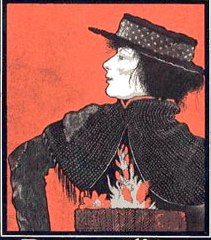 Analogy depicting Mrs. Patrick Campbell as Eliza Doolittle | |
| Written by | George Bernard Shaw |
| Characters |
|
| Date premiered | 16 October 1913 (1913-10-xvi) |
| Place premiered | Hofburg Theatre in Vienna, Austria |
| Genre | romantic comedy, social criticism |
| Setting | London, England |
Pygmalion is a play by George Bernard Shaw, named after the Greek mythological effigy. It premiered at the Hofburg Theatre in Vienna on 16 October 1913 and was first presented in English on phase to the public in 1913. Its English-language premiere took place at Her Majesty'south Theatre in the West End in April 1914 and starred Herbert Beerbohm Tree as phonetics professor Henry Higgins and Mrs Patrick Campbell as Cockney flower girl Eliza Doolittle.
In ancient Greek mythology, Pygmalion barbarous in love with one of his sculptures, which and then came to life. The full general thought of that myth was a popular subject for Victorian era British playwrights, including one of Shaw'south influences, W. South. Gilbert, who wrote a successful play based on the story called Pygmalion and Galatea that was kickoff presented in 1871. Shaw would likewise take been familiar with the musical Adonis and the burlesque version, Galatea, or Pygmalion Reversed. Shaw's play has been adapted numerous times, most notably as the 1938 flick Pygmalion, the 1956 musical My Off-white Lady and its 1964 flick version.
Shaw mentioned that the graphic symbol of Professor Henry Higgins was inspired by several British professors of phonetics: Alexander Melville Bong, Alexander J. Ellis, Tito Pagliardini, only in a higher place all, the cantankerous Henry Sweet.[one]
First productions [edit]

A Sketch Magazine illustration of Mrs. Patrick Campbell equally Eliza Doolittle from 22 April 1914. Shaw wrote the part of Eliza expressly for Campbell, who played opposite Herbert Beerbohm Tree as Henry Higgins.

After creating the office of Col. Pickering in the London production, Philip Merivale (second from right) played Henry Higgins opposite Mrs. Patrick Campbell (correct) when Pygmalion was taken to Broadway (1914)
Shaw wrote the play in early 1912 and read information technology to famed extra Mrs. Patrick Campbell in June. She came on board almost immediately, merely her balmy nervous breakdown contributed to the delay of a London production. Pygmalion premiered at the Hofburg Theatre in Vienna on 16 October 1913, in a German language translation by Shaw'southward Viennese literary agent and acolyte, Siegfried Trebitsch.[ii] [3] Its first New York production opened on 24 March 1914 at the German-language Irving Place Theatre.[4] Information technology opened in London on 11 April 1914, at Sir Herbert Beerbohm Tree'south His Majesty'southward Theatre, with Campbell as Eliza and Tree equally Higgins, and ran for 118 performances.[v] Shaw directed the actors through tempestuous rehearsals often punctuated by at least one of the two storming out of the theatre in a rage.[6]
Plot [edit]
Act I [edit]
A group of people are sheltering from the rain. Among them are the Eynsford-Hills, superficial social climbers eking out a living in "genteel poverty", consisting initially of Mrs. Eynsford-Hill and her daughter Clara. Clara's brother Freddy enters having earlier been dispatched to secure them a cab (which they tin can ill-afford), merely being rather timid and faint-hearted he has failed to do so. As he goes off once again to find a cab, he bumps into a flower girl, Eliza Doolittle. Her flowers driblet into the mud of Covent Garden, the flowers she needs to survive in her poverty-stricken world. Shortly, they are joined by a gentleman, Colonel Pickering. While Eliza tries to sell flowers to the Colonel, a bystander informs her that a man is writing down everything she says. The man is Henry Higgins, a linguist. Eliza worries that Higgins is a police officer and volition non at-home downward until Higgins introduces himself. It shortly becomes apparent that he and Colonel Pickering have a shared involvement in phonetics; indeed, Pickering has come from India to meet Higgins, and Higgins was planning to go to Bharat to run into Pickering. Higgins tells Pickering that he could pass off the bloom girl as a duchess merely by teaching her to speak properly. These words of bravado spark an involvement in Eliza, who would love to make changes in her life and go more than charming, even though, to her, it only ways working in a flower shop. At the finish of the act, Freddy returns later on finding a taxi, simply to notice that his mother and sis accept gone and left him with the cab. The streetwise Eliza takes the cab from him, using the money that Higgins tossed to her, leaving him on his own.
Act 2 [edit]

'Higgins' dwelling house – the next twenty-four hour period
As Higgins demonstrates his phonetics to Pickering, the housekeeper Mrs Pearce tells him that a young girl wants to see him. Eliza has shown up because she wishes to talk like a lady in a blossom store. She tells Higgins that she volition pay for lessons. He shows no involvement, but she reminds him of his boast the previous day. Higgins claimed that he could pass her for a duchess. Pickering makes a bet with him on his claim and says that he will pay for her lessons if Higgins succeeds. She is sent off to accept a bath. Mrs Pearce tells Higgins that he must deport himself in the young girl's presence, pregnant he must finish swearing, and improve his tabular array manners, but he is at a loss to sympathize why she should detect fault with him. Alfred Doolittle, Eliza'southward begetter, appears with the sole purpose of getting money out of Higgins, having no paternal interest in his girl's welfare. He sees himself equally a member of the undeserving poor, and means to go on being undeserving. With his intelligent mind untamed by education, he has an eccentric view of life. He is also ambitious, and when Eliza, on her return, sticks her tongue out at him, he goes to hit her, merely is prevented past Pickering. The scene ends with Higgins telling Pickering that they really have got a hard task on their hands.
Human action Three [edit]
Mrs. Higgins' drawing room
Higgins bursts in and tells his mother he has picked up a "mutual bloom daughter" whom he has been teaching. Mrs. Higgins is not very impressed with her son's attempts to win her approval because it is her 'at home' day and she is entertaining visitors. The visitors are the Eynsford-Hills. Higgins is rude to them on their arrival. Eliza enters and before long falls into talking about the conditions and her family unit. Whilst she is now able to speak in beautifully modulated tones, the substance of what she says remains unchanged from the gutter. She confides her suspicions that her aunt was killed by relatives, and mentions that gin had been "female parent's milk" to this aunt, and that Eliza's own begetter was always more cheerful subsequently a goodly amount of gin. Higgins passes off her remarks as "the new small talk", and Freddy is enraptured. When she is leaving, he asks her if she is going to walk beyond the park, to which she replies, "Walk? Not bloody likely!" (This is the most famous line from the play, and, for many years after the play's debut, use of the word 'bloody' was known every bit a pygmalion; Mrs. Campbell was considered to have risked her career by speaking the line on stage.[7]) Afterward she and the Eynsford-Hills go out, Henry asks for his mother'due south opinion. She says the girl is non presentable and is very concerned about what will happen to her, but neither Higgins nor Pickering understands her thoughts of Eliza's future, and leave feeling confident and excited about how Eliza will become on. This leaves Mrs. Higgins feeling exasperated, and exclaiming, "Men! Men!! Men!!!"
Deed 4 [edit]
Higgins' home – midnight
Higgins, Pickering, and Eliza take returned from a ball. A tired Eliza sits unnoticed, brooding and silent, while Pickering congratulates Higgins on winning the bet. Higgins scoffs and declares the evening a "lightheaded tomfoolery", thanking God it's over and saying that he had been sick of the whole thing for the last ii months. Still barely acknowledging Eliza beyond request her to exit a notation for Mrs. Pearce regarding java, the two retire to bed. Higgins returns to the room, looking for his slippers, and Eliza throws them at him. Higgins is taken aback, and is at first completely unable to empathise Eliza's preoccupation, which aside from being ignored after her triumph is the question of what she is to do at present. When Higgins does understand he makes light of it, saying she could get married, but Eliza interprets this as selling herself like a prostitute. "We were above that at the corner of Tottenham Courtroom Road." Finally she returns her jewelry to Higgins, including the band he had given her, which he throws into the fireplace with a violence that scares Eliza. Furious with himself for losing his atmosphere, he damns Mrs. Pearce, the java so Eliza, and finally himself, for "lavishing" his knowledge and his "regard and intimacy" on a "heartless guttersnipe", and retires in great dudgeon. Eliza roots around in the fireplace and retrieves the ring.
Act Five [edit]
Mrs. Higgins' drawing room – the next morning
Higgins and Pickering, perturbed past the discovery that Eliza has walked out on them, call on Mrs. Higgins to telephone the constabulary. Higgins is particularly distracted, since Eliza had causeless the responsibility of maintaining his diary and keeping track of his possessions, which causes Mrs. Higgins to decry their calling the police as though Eliza were "a lost umbrella". Doolittle is announced; he emerges dressed in fantabulous wedding attire and is furious with Higgins, who after their previous encounter had been and so taken with Doolittle's unorthodox ethics that he had recommended him as the "most original moralist in England" to a rich American founding Moral Reform Societies; the American had afterward left Doolittle a pension worth three thousand pounds a year, as a outcome of which Doolittle feels intimidated into joining the eye class and marrying his missus. Mrs. Higgins observes that this at to the lowest degree settles the problem of who shall provide for Eliza, to which Higgins objects – after all, he paid Doolittle 5 pounds for her. Mrs. Higgins informs her son that Eliza is upstairs, and explains the circumstances of her arrival, alluding to how marginalised and disregarded Eliza felt the previous night. Higgins is unable to appreciate this, and sulks when told that he must behave if Eliza is to join them. Doolittle is asked to look outside.
Eliza enters, at ease and self-possessed. Higgins blusters but Eliza isn't shaken and speaks exclusively to Pickering. Throwing Higgins' previous insults back at him ("Oh, I'm only a squashed cabbage leaf"), Eliza remarks that it was only by Pickering's example that she learned to be a lady, which renders Higgins speechless. Eliza goes on to say that she has completely left backside the blossom girl she was, and that she couldn't utter any of her quondam sounds if she tried – at which signal Doolittle emerges from the balcony, causing Eliza to relapse totally into her gutter speech communication. Higgins is jubilant, jumping up and exultation over her. Doolittle explains his situation and asks if Eliza will come with him to his wedding. Pickering and Mrs. Higgins also agree to get, and leave with Doolittle and Eliza to follow.
The scene ends with another confrontation between Higgins and Eliza. Higgins asks if Eliza is satisfied with the revenge she has brought thus far and if she will now come back, only she refuses. Higgins defends himself from Eliza's earlier accusation past arguing that he treats everyone the same, so she shouldn't experience singled out. Eliza replies that she just wants a niggling kindness, and that since he volition never finish to show her this, she will non come up back, but will marry Freddy. Higgins scolds her for such low ambitions: he has made her "a consort for a king." When she threatens to teach phonetics and offer herself as an assistant to Higgin's academic rival Nepommuck, Higgins once more loses his temper and promises to wring her neck if she does so. Eliza realises that this concluding threat strikes Higgins at the very core and that information technology gives her power over him; Higgins, for his part, is delighted to see a spark of fight in Eliza rather than her quondam fretting and worrying. He remarks "I like y'all like this", and calls her a "pillar of force". Mrs. Higgins returns and she and Eliza depart for the wedding. As they leave, Higgins incorrigibly gives Eliza a number of errands to run, as though their contempo chat had non taken place. Eliza disdainfully explains why they are unnecessary and wonders what Higgins is going to practise without her (in another version, Eliza disdainfully tells him to practise the errands himself; Mrs. Higgins says that she'll go the items, but Higgins cheerfully tells her that Eliza will practice information technology after all). Higgins laughs to himself at the idea of Eliza marrying Freddy as the play ends.
Disquisitional reception [edit]
The play was well received past critics in major cities following its premieres in Vienna, London, and New York. The initial release in Vienna garnered several reviews describing the evidence as a positive divergence from Shaw'south usual dry out and didactic fashion.[8] The Broadway premiere in New York was praised in terms of both plot and acting, described as "a honey story with brusque diffidence and a wealth of humor."[9] Reviews of the production in London were slightly less unequivocally positive, with The Telegraph noting that the play was deeply diverting with interesting mechanical staging, although the critic ultimately found the product somewhat shallow and overly lengthy.[ten] The Times, however, praised both the characters and actors (especially Sir Herbert Tree equally Higgins and Mrs. Patrick Campbell as Eliza) and the happy if "unconventional" ending.[xi] [12]
Ending [edit]
Pygmalion was the most broadly appealing of all Shaw's plays. Simply popular audiences, looking for pleasant entertainment with big stars in a W End venue, wanted a "happy ending" for the characters they liked and then well, as did some critics.[13] During the 1914 run, Tree sought to sweeten Shaw's ending to please himself and his record houses.[14] Shaw remained sufficiently irritated to add a postscript essay, "'What Happened Afterwards",[15] to the 1916 print edition for inclusion with subsequent editions, in which he explained precisely why information technology was impossible for the story to end with Higgins and Eliza getting married.
He continued to protect what he saw as the play'south, and Eliza's, integrity by protecting the last scene. For at to the lowest degree some performances during the 1920 revival, Shaw adjusted the ending in a way that underscored the Shavian bulletin. In an undated note to Mrs. Campbell he wrote,
When Eliza emancipates herself – when Galatea comes to life – she must not relapse. She must retain her pride and triumph to the end. When Higgins takes your arm on 'espoused battleship' you lot must instantly throw him off with implacable pride; and this is the note until the final 'Buy them yourself.' He will go out on the balcony to sentry your departure; come up dorsum triumphantly into the room; exclaim 'Galatea!' (meaning that the statue has come up to life at terminal); and – mantle. Thus he gets the terminal word; and yous get information technology too.[16]
(This ending, notwithstanding, is not included in any print version of the play.)
Shaw fought against a Higgins-Eliza happy-stop pairing as tardily as 1938. He sent the 1938 flick version'south producer, Gabriel Pascal, a concluding sequence which he felt offered a fair compromise: a tender farewell scene between Higgins and Eliza, followed by one showing Freddy and Eliza happy in their greengrocery-flower store. Merely at the sneak preview did he larn that Pascal had finessed the question of Eliza's future with a slightly ambiguous last scene in which Eliza returns to the business firm of a sadly musing Higgins and self-mockingly quotes her previous self announcing, "I washed my face up and hands earlier I come, I did".
Different versions [edit]
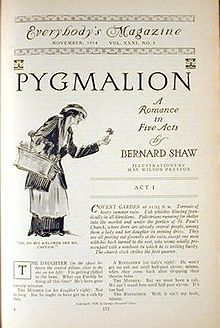
There are 2 main versions of the play in circulation. One is based on the before version, first published in 1914; the other is a later on version that includes several sequences revised by Shaw, starting time published in 1941. Therefore, different editions of the play omit or add certain lines. For instance, the Project Gutenberg version published online, which is transcribed from an early version, does non include Eliza's exchange with Mrs. Pearce in Act II, the scene with Nepommuck in Act III, or Higgins' famous declaration to Eliza, "Yep, you squashed cabbage-leaf, yous disgrace to the noble architecture of these columns, you incarnate insult to the English language! I could laissez passer you off as the Queen of Sheba!" – a line and so famous that it is at present retained in nearly all productions of the play, including the 1938 film version of Pygmalion likewise as in the stage and film versions of My Fair Lady.[17]
The co-managing director of the 1938 motion-picture show, Anthony Asquith, had seen Mrs. Campbell in the 1920 revival of Pygmalion and noticed that she spoke the line, "It'south my conventionalities as how they done the old adult female in." He knew "equally how" was not in Shaw's text, only he felt information technology added color and rhythm to Eliza'southward speech communication, and liked to think that Mrs. Campbell had ad libbed it herself. 18 years after he added it to Wendy Hiller's line in the picture.[half dozen]
In the original play Eliza's test is met at an ambassador'south garden party, offstage. For the 1938 film Shaw and co-writers replaced that exposition with a scene at an embassy brawl; Nepommuck, the blackmailing translator spoken most in the play, is finally seen, but his name is updated to Aristid Karpathy – named so past Gabriel Pascal, the film's Hungarian producer, who also made sure that Karpathy mistakes Eliza for a Hungarian princess. In My Fair Lady he became Zoltan Karpathy. (The alter of name was probable to avert offending the sensibilities of Roman Catholics, as St. John Nepomuk was, ironically, a Cosmic martyr who refused to divulge the secrets of the confessional.)
The 1938 film besides introduced the famous pronunciation exercises "the pelting in Spain stays mainly in the plain" and "In Hertford, Hereford, and Hampshire, hurricanes hardly ever happen".[18] Neither of these appears in the original play. Shaw's screen version of the play too equally a new print version incorporating the new sequences he had added for the film script were published in 1941. Many of the scenes that were written for the films were separated past asterisks, and explained in a "Note for Technicians" department.
Influence [edit]
Pygmalion remains Shaw's almost popular play. The play'southward widest audiences know it equally the inspiration for the highly romanticized 1956 musical and 1964 motion picture My Off-white Lady.
Pygmalion has transcended cultural and language barriers since its first production. The British Museum contains "images of the Polish production...; a series of shots of a wonderfully Gallicised Higgins and Eliza in the beginning French production in Paris in 1923; a fascinating prepare for a Russian production of the 1930s. There was no state which didn't have its own 'take' on the subjects of class division and social mobility, and it'southward every bit enjoyable to view these subtle differences in settings and costumes as information technology is to imagine translators wracking their brains for their own equivalent of 'Non encarmine likely'."[19]
Joseph Weizenbaum named his chatterbot estimator plan ELIZA subsequently the graphic symbol Eliza Doolittle.[twenty]
Notable productions [edit]

- 1914: Sir Herbert Beerbohm Tree and Mrs Patrick Campbell at His Majesty's Theatre
- 1914: Philip Merivale and Mrs Patrick Campbell at three Broadway theatres [Park, Freedom and Wallack's] (United states of america)
- 1920: C Aubrey Smith and Mrs Patrick Campbell at the Aldwych Theatre
- 1926: Reginald Mason and Lynn Fontanne at the Order Theatre (The states)
- 1936: Ernest Thesiger and Wendy Hiller at the Festival Theatre, Malvern
- 1937: Robert Morley and Diana Wynyard at the Old Vic Theatre
- 1945: Raymond Massey and Gertrude Lawrence at the Ethel Barrymore Theatre (The states)
- 1947: Alec Clunes and Brenda Bruce at the Lyric Theatre, Hammersmith
- 1953: John Clements and Kay Hammond at the St James's Theatre
- 1965: Ian White and Jane Asher at the Watford Palace Theatre
- 1974: Alec McCowen and Diana Rigg at the Albery Theatre
- 1984: Peter O'Toole and Jackie Smith-Forest at the Shaftesbury Theatre
- 1987: Peter O'Toole and Amanda Plummer at the Plymouth Theatre (U.s.)
- 1992: Alan Howard and Frances Barber at the Regal National Theatre
- 1997: Roy Marsden and Carli Norris (who replaced Emily Lloyd early on in rehearsals) at the Albery Theatre[21]
- 2007: Tim Pigott-Smith and Michelle Dockery at the Old Vic Theatre
- 2007: Jefferson Mays and Claire Danes at American Airlines Theatre (U.s.)
- 2010: Simon Robson and Cush Colossal at the Royal Substitution Theatre, Manchester
- 2011: Rupert Everett (later on Alistair McGowan) and Kara Tointon at the Garrick Theatre[22]
- 2011: Risteárd Cooper and Charlie Murphy at the Abbey Theatre, Dublin
Adaptations [edit]

- Stage
- My Fair Lady (1956), the Broadway musical by Lerner and Loewe (based on the 1938 film), starring King Harrison as Higgins and Julie Andrews as Eliza
- Film
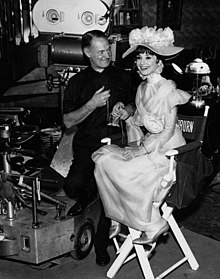
Cinematographer Harry Stradling poses with Audrey Hepburn as Eliza Doolittle on the set of the 1964 movie musical My Off-white Lady.
- Pygmalion (1935), a German language film accommodation by Shaw and others, starring Gustaf Gründgens as Higgins and Jenny Jugo equally Eliza. Directed by Erich Engel.
- Hoi Polloi (1935), a short characteristic starring The Three Stooges comedy team. To win a bet, a professor attempts to transform the Stooges into gentlemen.
- Pygmalion (1937), a Dutch motion-picture show adaptation, starring Johan De Meester equally Higgins and Lily Bouwmeester as Elisa. Directed by Ludwig Berger.
- Pygmalion (1938), a British pic adaptation by Shaw and others, starring Leslie Howard equally Higgins and Wendy Hiller as Eliza
- Kitty (1945), a picture show based on the novel of the aforementioned proper name by Rosamond Marshall (published in 1943). A broad interpretation of the Pygmalion story line, the moving-picture show tells the rags-to-riches story of a immature guttersnipe, Cockney girl.
- My Off-white Lady (1964), a film version of the musical starring Audrey Hepburn every bit Eliza and Male monarch Harrison equally Higgins
- The Opening of Misty Beethoven (1976), an American hardcore pornography film take-off starring Constance Money and Jamie Gillis
- She's All That (1999): a modern, teenage take on Pygmalion
- The Duff (2015): based on the novel of the same proper noun past Kody Keplinger, which in turn is a mod teenage adaption of Pygmalion
- He'south All That (2021): a Netflix Original pic that'due south a gender-bandy retelling of the 1999 teen comedy; featuring Addison Rae and Rachael Leigh Cook
- Television
- A 1948 BBC Goggle box version starring Margaret Lockwood as Eliza and Ralph Michael every bit Higgins
- A 1963 Authentication Hall of Fame production of Pygmalion, starring Julie Harris as Eliza and James Donald every bit Higgins
- Pigmalião lxx, a 1970 Brazilian telenovela, starring Sérgio Cardoso, and Tônia Carrero
- Pygmalion (1973), a BBC Play of the Month version starring James Villiers as Higgins and Lynn Redgrave equally Eliza
- Pygmalion (1981), a film version starring Twiggy as Eliza and Robert Powell equally Higgins
- Pygmalion (1983), an adaptation starring Peter O'Toole as Higgins and Margot Kidder equally Eliza
- The Makeover, a 2013 Hallmark Hall of Fame mod accommodation of Pygmalion, starring Julia Stiles and David Walton and directed by John Gray[23] [24]
- Selfie, a 2014 tv set sitcom on ABC, starring Karen Gillan and John Cho.
- Classic Alice, a webseries, aired a 10-episode adaptation on YouTube, starring Kate Hackett and Tony Noto in 2014.
- Totalmente Demais, a 2015 Brazilian telenovela, starring Juliana Paes, Marina Ruy Barbosa and Fábio Assunção.
The BBC has broadcast radio adaptations at least twice, in 1986 directed by John Tydeman and in 2021 directed by Emma Harding.
- Not–English linguistic communication
- Pigmalió, an accommodation past Joan Oliver into Catalan. Set in 1950s Barcelona, it was showtime staged in Sabadell in 1957 and has had other stagings since.
- Ti Phulrani, an adaptation by Pu La Deshpande in Marathi. The plot follows Pygmalion closely but the language features are based on Marathi.
- Santu Rangeeli, an accommodation by Madhu Rye and Pravin Joshi in Gujarati.
- A 1996 television play in Polish, translated by Kazimierz Piotrowski, directed by Maciej Wojtyszko and performed at Teatr Telewizji (Polish Television studio in Warsaw) by some of the top Polish actors at the time. It has been aired on national TV numerous times since its TV premiere in 1998.
- A 2007 adaptation past Aka Morchiladze and Levan Tsuladze in Georgian performed at the Marjanishvili Theatre in Tbilisi
- Man Pasand, a 1980 Hindi movie directed past Basu Chatterjee
- Ogo Bodhu Shundori, a 1981 Bengali comedy film starring Uttam Kumar directed by Salil Dutta
- My Young Auntie, a 1981 Hong Kong action pic directed past Lau Kar-Leung
- Laiza Porko Sushi, a Papiamentu adaptation from author and artist May Henriquez
- Gönülcelen, a Turkish serial starring Tuba Büyüküstün and Cansel Elcin
- Δύο Ξένοι, a Greek serial starring Nikos Sergianopoulos and Evelina Papoulia
In popular culture [edit]
Films [edit]
- The First Night of Pygmalion (1972), a play depicting the backstage tensions during the get-go British production.
- Willy Russell'southward 1980 stage one-act Educating Rita and the subsequent film accommodation are similar in plot to Pygmalion. [25]
- Trading Places (1983), a film starring Eddie Murphy and Dan Aykroyd.[26]
- Pretty Woman (1990), a motion picture starring Julia Roberts and Richard Gere.[27]
- Mighty Aphrodite (1995) a film directed by Woody Allen.[28]
- She's All That (1999), a film starring Rachael Leigh Cook and Freddie Prinze Jr.[29]
- Confessions of a Teenage Drama Queen (2004), a film starring Lindsay Lohan where she auditions for a modernized musical version of Pygmalion called "Eliza Rocks".[30]
- Carmine Sparks (2012), a film written past and starring Zoe Kazan explores a writer (played by Paul Dano) who falls in dear with his own fictional character who becomes existent.[31]
Tv [edit]
- Moonlighting 's second-season episode "My Off-white David" (1985) is inspired by the picture My Fair Lady, in a plot where Maddie Hayes makes a bet with David Addison consisting in making him softer and more serious with work. She is her Henry Higgins, while he is put in the Eliza Doolittle position, as the funny, clumsy, awkward role of the relationship.
- The Man from U.Due north.C.L.E. 'due south third-flavor episode "The Galatea Affair" (1966) is a spoof of My Fair Lady. A crude barroom entertainer (Joan Collins) is taught to comport like a lady. Noel Harrison, son of Rex Harrison, star of the My Off-white Lady film, is the guest star.
- In The Beverly Hillbillies episode "Pygmalion and Elly" Sonny resumes his high-class courtship of Elly May past playing Julius Caesar and Pygmalion.
- In The Andy Griffith Show season 4 episode "My Fair Ernest T. Bass", Andy and Barney attempt to plow the mannerless Ernest T. Bass into a presentable admirer. References to "Pygmalion" abound: Bass' manners are tested at a social gathering, where he is causeless by the hostess to be a human being from Boston. Several characters comment "if yous wrote this into a play nobody'd believe information technology."
- In Doctor Who, the character of Leela is loosely based on Eliza Doolittle. She was a regular in the programme from 1977 to 1978, and later on reprised in audio dramas from 2003 to present. In Ghost Light, the graphic symbol of Control is heavily based upon Eliza Doolittle, with Redvers Fenn-Cooper in a similar role as Henry Higgins; the story also features reference to the "Rain in Spain" rhyme and the Doctor referring to companion Ace as "Eliza".
- In the Remington Steele flavor 2 episode "My Off-white Steele", Laura and Steele transform a truck stop waitress into a socialite to flush out a kidnapper. Steele references the 1938 movie Pygmalion and My Fair Lady, and references the fashion in which Laura has "molded" him into her fictional creation.
- In the Magnum, P.I. episode "Professor Jonathan Higgins" of Season 5, Jonathan Higgins tries to plough his punk rocker cousin into a loftier society socialite. Higgins references Pygmalion in the episode.
- The Simpsons episode titled "Pygmoelian" is inspired by Pygmalion, in which ugly barman Moe Szyslak has a facelift. It was also parodied to a heavier extent in the episode "My Fair Laddy", where the grapheme being changed is uncouth Scotsman Groundskeeper Willie, with Lisa Simpson taking the Henry Higgins part.
- The Family unit Guy episode "Ane If Past Clam, 2 If By Body of water" involves a subplot with Stewie trying to refine Eliza Pinchley, his new Cockney-accented neighbour, into a proper immature lady. He makes a bet with Brian that he can improve Eliza's vocabulary and go her to speak without her accent before her birthday party. Includes "The Life of the Wife", a parody of the vocal "The Rain in Spain" (from My Fair Lady). The voice of Stewie was in fact originally based on that of Male monarch Harrison.
- The plot of the Star Trek: Voyager episode "Someone to Scout Over Me" is loosely based on Pygmalion, with the send'south holographic doctor playing the role of Higgins to the ex-Borg Seven of Nine.
- In the Boy Meets Earth episode "Turnaround", Cory and Shawn learn about "Pygmalion" in grade, paralleling their endeavor with Cory's uncool engagement to the dance.
- The iCarly episode "iMake Sam Girlier" is loosely based on Pygmalion.[ commendation needed ]
- The Flavor seven King of the Hill episode "Pigmalian" describes an unhinged local pig magnate who attempts to transform Luanne into the idealized woman of his visitor'south old advertisements.
- In The Rex of Queens episode "Gambling North'Diction" Carrie tries to lose her accent for a chore promotion by existence taught by Spence. The episode was renamed to "Carrie Doolittle" in Deutschland.
- In 2014, ABC debuted a romantic situational comedy titled Selfie, starring Karen Gillan and John Cho. It is a modern-day adaptation that revolves effectually an image-obsessed woman named Eliza Dooley (Gillan) who comes under the social guidance of marketing image guru Henry Higgs (Cho).
- In the Malaysian drama Nur, Pygmalion themes are axiomatic. The lives of a pious, ethical man and a sex worker are considered within the context of Islam, societal expectations and norms.
References [edit]
- ^ George Bernard Shaw, Androcles and the King of beasts: Overruled : Pygmalion (New York City: Brentano's, 1918), page 109. Archived 14 Dec 2016 at the Wayback Machine (Annotation: Alexander M. Bell'south first wife was named Eliza.)
- ^ "Theses & Briefing Papers". Archived from the original on 24 September 2015.
- ^ Shaw, Bernard, edited by Samuel A. Weiss (1986). Bernard Shaw's Letters to Siegfried Trebitsch. Stanford, Calif.: Stanford Academy Printing. ISBN 0-8047-1257-iii, p.164.
- ^ "Herr G.B. Shaw at the Irving Identify." Archived 26 April 2016 at the Wayback Car The New York Times Archived 23 August 2015 at the Wayback Machine 25 March 1914. In belatedly 1914 Mrs Campbell took the London company to tour the United States, opening in New York at the Belasco Theatre.
- ^ Laurence, Dan, ed. (1985). Bernard Shaw: Nerveless Messages, 1911–1925. New York: Viking. p. 228. ISBN0-670-80545-9.
- ^ a b Dent, Alan (1961). Mrs. Patrick Campbell. London: Museum Press Limited.
- ^ The Truth About Pygmalion by Richard Huggett, 1969 Random House, pp. 127–128
- ^ "The Minor Shaw Again: Explains in His Shrinking Way Why "Pygmalion" Was First Done in Berlin;- Critics Like It". The New York Times. 23 November 1913. ProQuest 97430789.
- ^ "Shaw'due south 'Pygmalion' Has Come up to Town: With Mrs. Campbell Delightful as a Galatea from Tottenham Courtroom Road – A Mildly Romantic Thousand. B. S. – His Latest Play Tells a Honey Story with Curt Diffidence and a Wealth of Humor". The New York Times. 13 October 1914. ProQuest 97538713.
- ^ "Pygmalion, His Majesty'southward Theatre, 1914, review". The Telegraph. 11 April 2014. Archived from the original on 8 Feb 2017. Retrieved nineteen September 2016.
- ^ "The Story Of "Pygmalion."". The Times. xix March 1914. Archived from the original on 8 February 2017. Retrieved nineteen September 2016 – via Gale.
- ^ "Viewing 1914/three/nineteen Folio 11 - The Story Of "Pygmalion."". www.thetimes.co.britain. Archived from the original on 24 February 2021. Retrieved 2 Nov 2020.
- ^ Evans, T.F. (ed.) (1997). George Bernard Shaw (The Critical Heritage Series). ISBN 0-415-15953-9, pp. 223–xxx.
- ^ "From the Bespeak of View of A Playwright," by Bernard Shaw, collected in Herbert Beerbohm Tree, Some Memories of Him and His Fine art, Collected past Max Beerbohm (1919). London: Hutchinson, p. 246. Versions at Text Archive Internet Archive
- ^ Shaw, G.B. (1916). Pygmalion. New York: Brentano. Sequel: What Happened Afterwards. Archived xvi February 2010 at the Wayback Machine Bartleby: Keen Books Online. Archived 30 December 2009 at the Wayback Machine
- ^ "The Instinct of An Artist: Shaw and the Theatre." Archived 8 May 2010 at the Wayback Car Catalog for "An Exhibition from The Bernard F. Burgunder Collection," 1997. Cornell University Library Archived 26 September 2013 at the Wayback Car
- ^ "The Project Gutenberg E-text of Pygmalion, by George Bernard Shaw". Archived from the original on v September 2015. Retrieved 29 March 2015.
- ^ Pascal, Valerie, The Disciple and His Devil, McGraw-Hill, 1970. p. 83."
- ^ "The lesson of a Shine production of 'Pygmalion.'" Archived 18 March 2017 at the Wayback Car The Independent on Sunday, 3 July 2001. The Independent Archived ii October 2002 at the Wayback Machine Archived ii October 2002 at the Wayback Machine
- ^ Markoff, John (13 March 2008), "Joseph Weizenbaum, Famed Developer, Is Expressionless at 85", The New York Times, archived from the original on 1 Apr 2011, retrieved 7 January 2009
- ^ British Theatre Guide (1997)
- ^ Tointon'south indisposition on 25 Baronial 2011 enabled understudy Rebecca Birch to make her West End début in a leading part (insert to Garrick Theatre plan for Pygmalion).
- ^ "Julia Stiles Stars in The Makeover". Archived from the original on i Jan 2013. Retrieved 21 Jan 2013.
- ^ "IMDb: The Makeover". IMDb. Archived from the original on 19 Jan 2018. Retrieved 30 June 2018.
- ^ "Willy Russell: Welcome". Archived from the original on 15 July 2007. Retrieved 20 July 2007.
- ^ "Is 'Trading Places' the ultimate New year's day's Eve film of the '80s?". Tampa Bay Times . Retrieved xx June 2021.
- ^ "Pretty Woman vs. Pygmalion Essay - 1024 Words | Bartleby". www.bartleby.com. Archived from the original on 24 June 2021. Retrieved twenty June 2021.
- ^ "Mira Sorvino: 'I'm non certain I'd accept the Mighty Aphrodite role now'". The Guardian. 30 October 2014. Archived from the original on xiv June 2021. Retrieved xx June 2021.
- ^ Ebert, Roger. "She's All That movie review & film summary (1999) | Roger Ebert". rogerebert.com. Archived from the original on 24 June 2021. Retrieved xx June 2021.
- ^ Kehr, Dave (twenty February 2004). "FILM REVIEW; A Teenager Struggles to Star in Her New Town". The New York Times. ISSN 0362-4331. Archived from the original on 24 June 2021. Retrieved 20 June 2021.
- ^ "Pygmalion was muse behind 'Ruby Sparks'". Los Angeles Times. fourteen July 2012. Archived from the original on 24 June 2021. Retrieved twenty June 2021.
External links [edit]
- Pygmalion at Standard Ebooks
- Pygmalion at the Internet Broadway Database
- Pygmalion stories & art: "successive retellings of the Pygmalion story after Ovid'southward Metamorphoses"
- Pygmalion at Project Gutenberg
-
 Pygmalion public domain audiobook at LibriVox
 - Shaw'due south Pygmalion was in a unlike class 2014 Irish Examiner article by Dr. R. Hume
- "Bernard Shaw Snubs England and Amuses Germany." The New York Times, 30 Nov 1913. This article quotes the original script at length ("translated into the vilest American": Letters to Trebitsch, p. 170), including its last lines. Its author, too, hopes for a "happy catastrophe": that after the curtain Eliza volition return bearing the gloves and tie.
Source: https://en.wikipedia.org/wiki/Pygmalion_(play)

Post a Comment for "Who Does Henry Higgins Bet Again"